|
|
|
|
|
|
The Incredible Caravan of BooksIsobel DixonYurt (noun): a circular tent consisting of a framework of poles covered with felt or skins, used by Mongolian and Turkic nomads of E and central Asia [ETYMOLOGY: from Russian yurta, of Turkic origin; compare Turkish yurt abode, home] Spiegeltent (noun): a hand-hewn pavilion built of wood, mirrors, canvas, leaded glass and detailed in velvet and brocade. Spiegeltents have been used as travelling dance-halls and wine-tasting marquees since the early twentieth century. Mention Edinburgh and people are bound to think of bagpipes and haggis, tartan and the castle. Perhaps of the ever-changeable Scottish weather. Tents wouldn’t be high on many lists, but now I find that Edinburgh and its book festival, with white marquees, its nomads’ yurt and Spiegeltent, are inextricably — and happily — linked in my mind. The Edinburgh International Festival was founded in 1948 — in the face of post-war gloom — and is now a world-famous annual celebration of music, theatre and dance. The Edinburgh International Book Festival is much younger, founded only in 1983 (biennial at first, it became an annual event in 1997), but has blossomed, after some initial setbacks. With the Fringe, Jazz and Film Festivals also held in August each year, the city teems with entertainment-seeking visitors. Finding some entertainment to your taste is pretty much guaranteed — though the weather, of course, is not.
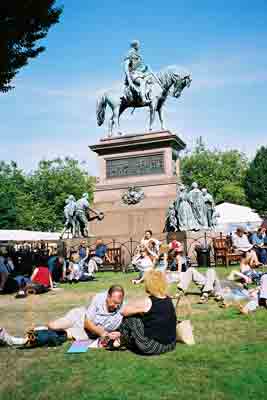
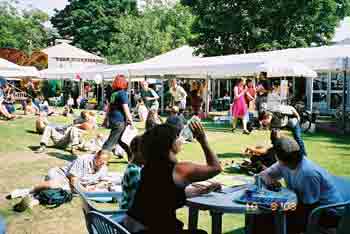
This year, Europe’s heat wave meant that few could complain about the weather in Scotland. Day after August day, Auld Reekie was swathed in glorious sunshine — glinting off the dark basalt rock of Castlehill, burnishing the flowers in Princes’ Street Gardens, and shining down on Charlotte Square, Robert Adam’s gracious Georgian square in the west end of the New Town. In the gardens at its heart, a clustering of tents was dappled by the light sifting through the tall trees above them. Authors and book lovers, young and old, wandered or hurried to and from the marquees. In between events people lingered on the lawns, reading newspapers, the programme, or the books they had bought. There were children too, in prams, playing with balloons, paging through books. Happily, it is a particularly child-friendly festival with many events for children and their parents. A somewhat different scene from last year, when Etienne van Heerden was at the Festival reading and talking about his novel The long silence of Mario Salviati: then drenching rain had made the duckboard walkways criss-crossing between tents the only viable route through the mud. But it didn’t seem to dampen the enthusiasm of those who came to listen. After Etienne’s sold-out reading with New Zealand writer CK Stead, an elderly gentleman stood up, his voice trembling with emotion, and said he could hardly bear to hear an author reading about South Africa, it made him feel so homesick. He mused on the World War II POW character in the novel and his own stint in the army, then sat down, again expressing his gratitude. Not a question exactly, but a rather poignant moment illustrating how much readers can identify with books, and how they want to grasp the chance to move beyond the page and relate directly to the creator of the stories that have touched them. In Scotland’s Sunday Herald, Catherine Lockerbie, the Festival Director, described how one of this year’s featured writers, Chilean novelist and human rights activist Ariel Dorfman, gave a lecture “that dumps apathy in the gutter where it belongs”. This prompted a distinguished-looking man in the signing queue, to announce that “deeply moved by the speech, he has decided to change his career to something that will bring benefit to his fellow humans, not profit to himself. ‘You have agitated my heart,’ he declares.” The spread of ideas, the agitation of the heart, what higher aim could there be for a festival of books? For many writers, even those who don’t enjoy the performance and public speaking aspect of literary festivals, these personal encounters can be immensely heartening. They prove that something of the solitary enterprise of writing has communicated something worthwhile after all.
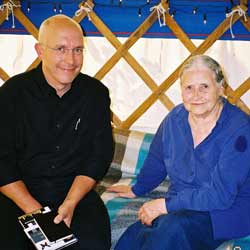
But the Festival aims not only to bring readers into contact with writers and their ideas, it also prides itself on providing a stimulating forum where writers can meet other writers. The nomad’s yurt is the authors’ space to meet and relax, lounge on cushion-strewn couches, sipping a refreshing cuppa or a fortifying nip of Glenmorangie. Catherine Lockerbie, the benign calm Madonna of Charlotte Square Gardens, reveals her pleasure at the possibilities this welcoming space affords when she writes of such a meeting: “Susan Sontag, dark mane flowing, sits down beside diminutive Doris Lessing, two of the most striking minds and faces in literature.” And I also took great delight in introducing my client Sandy Balfour, author of Pretty girl in crimson rose (8), his “Memoir of Love, Exile and Crosswords” to Doris Lessing, who had read and loved his book so much that her quote — “witty and ingenious” — graces its cover. This year 185 000 people attended the Festival and I’m told that, in the glorious weather, over 1 574 litres of ice-cream were sold — and eaten — on site this year! But it wasn’t just at the ice-cream stand that queues formed. Almost half the events sold out completely, and it was not unusual to see long lines snaking out of the signing tent, with fans clutching books — sometimes the new-new thing, sometimes an old favourite. Catherine Lockerbie describes the signing queue as the “scene of so many brief but resonant encounters”, and one of the good things about readers being able to meet authors in this kind of intimate forum is the fact that it can stimulate interest in all the author’s work, in the range of ideas, not just the most recently reviewed title.
The Festival runs its own independent bookselling operation, and all proceeds are ploughed back into the running costs — an important contribution to the 80 percent of funding raised directly by its not-for-profit organisation. Statistics also show that book sales throughout the city rise during the Festival, not only at the on-site store itself — a welcome ripple effect. From small beginnings the Festival has grown in size and stature and success. The city of Robert Louis Stevenson, Walter Scott and David Hume — and more recently Muriel Spark, Irvine Welsh, Ian Rankin and JK Rowling — has added immeasurably to its cultural capital by welcoming this motley caravan of international writers with their diverse treasure of ideas each year. Returning from a vibrant week, I am saddened that the planned 2004 South African International Festival of Books in Cape Town has been postponed, as it seems that creating a similar celebration of books and ideas in Cape Town has tremendous potential and is perfectly achievable. One could do well to look to how the Scottish city made it happen. Among the key principles are that they began small, moved from every second year to annual, and learned from their mistakes. The Festival has one central, manageable site, albeit bustling with activity. (The sign lashed to the railings sums up the appeal of this rather well: “650 events. 550 authors. One beautiful garden.”) They have a dedicated full-time director and a team that has been enabled to grow along with the success and demands of the Festival. And they keep the writer at the heart of the endeavour — inviting an interesting mix of writers (not just the usual suspects) and taking good care of them so they will wish to return, although no huge appearance fees are paid — indeed many authors donate their fees back to the Festival’s funds — and no author gets star treatment above others. They embrace their Scottishness, but are not insular — aiming to be both “a local festival for international authors and an international festival for local authors”. The authors love the city, the festival and the chance to meet other writers of quality. And happy authors mean happy audiences, who, likewise, will return for more. The Festival’s slogan is “A book is like a garden carried in the pocket”. You can count the ice-creams and tickets, and even the books, but it is impossible to measure the memories and ideas that people take away with them, and how what is seeded in a small square in a far northern city can bloom all year round, surprisingly, anywhere. Long may it bloom, and let’s hope we soon find a way to cultivate our own hardy hybrid on home soil — many-branched, exotic, yet uniquely South African.
|
||||
© Kopiereg in die ontwerp en inhoud van hierdie webruimte behoort aan LitNet, uitgesluit die kopiereg in bydraes wat berus by die outeurs wat sodanige bydraes verskaf. LitNet streef na die plasing van oorspronklike materiaal en na die oop en onbeperkte uitruil van idees en menings. Die menings van bydraers tot hierdie werftuiste is dus hul eie en weerspieël nie noodwendig die mening van die redaksie en bestuur van LitNet nie. LitNet kan ongelukkig ook nie waarborg dat hierdie diens ononderbroke of foutloos sal wees nie en gebruikers wat steun op inligting wat hier verskaf word, doen dit op hul eie risiko. Media24, M-Web, Ligitprops 3042 BK en die bestuur en redaksie van LitNet aanvaar derhalwe geen aanspreeklikheid vir enige regstreekse of onregstreekse verlies of skade wat uit sodanige bydraes of die verskaffing van hierdie diens spruit nie. LitNet is ’n onafhanklike joernaal op die Internet, en word as gesamentlike onderneming deur Ligitprops 3042 BK en Media24 bedryf. |
|||||